2023 St. Clair County, Alabama Demographics | Data & Analysis

Ready-to-use reports, analytics, and visualizations covering St. Clair County, Alabama, including population, race, income, and more. Based on 2023 American Community Survey Estimates.

St. Clair County, Alabama Key Demographic Statistics (2023 Estimates)

Key demographic statistics summarized from the U.S. Census Bureau's 2023 American Community Survey (ACS).

Total Population
92,903
Median Age
41.0 years
Median Household Income
$78,993
Median Property Value
$218,500
Bachelor's Degree+
19.94%
Uninsured Rate
7.3%
Total Households
34,477
Total Workers
42,532
Citizenship Rate
99.2%
Total Veterans
4,770
Top Veteran Era
Vietnam Era Only
Poverty Rate
7.6%
Families in Poverty
1,895
SNAP Recipients
10.39%
Households w/ SNAP
3,581

Source: U.S. Census Bureau, 2023 American Community Survey (ACS) Estimates

St. Clair County, Alabama Demographics: Age & Gender Distribution (2023)
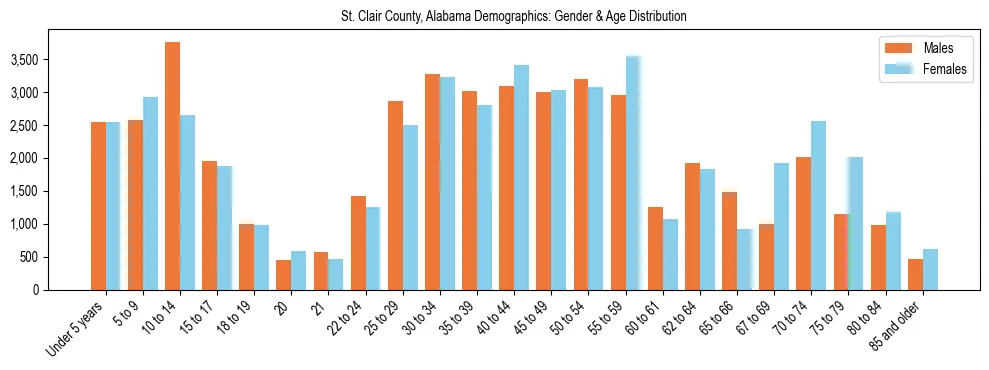
Population pyramid for St. Clair County, Alabama showing male vs female age distribution based on 2023 ACS data.
Figure 1: Population distribution by age and sex in St. Clair County, Alabama. Source: U.S. Census Bureau, 2023 ACS Estimates.

Key Demographic Indicators for St. Clair County, Alabama

The following statistics highlight St. Clair County, Alabama population and median age, based on U.S. Census Bureau 2023 ACS Estimates.

Total Population
92,903
Median Age (Total)
41.0 years
Median Age (Male)
38.9 years
Median Age (Female)
42.2 years

St. Clair County, Alabama Population Age Distribution 2023

Table 1: Percentage distribution of population by age group in St. Clair County, Alabama, 2023
Age CohortShare of Population
Under 5 years5.49%
5–17 years (Children)16.92%
18–24 years (Young Adults)7.25%
25–34 years12.77%
35–54 years26.51%
55–64 years13.54%
65 years and over (Seniors)17.53%

Dependency Ratios Analysis

Total Dependency Ratio
66.48
Youth Dependency Ratio
37.30 Population under 18 relative to working age (18-64).
Old-Age Dependency Ratio
29.18 Population 65+ relative to working age (18-64).

A higher ratio indicates a greater financial and social burden on the working population to support non-working age groups.


What is the Racial and Ethnic Breakdown of St. Clair County, Alabama (2023)?
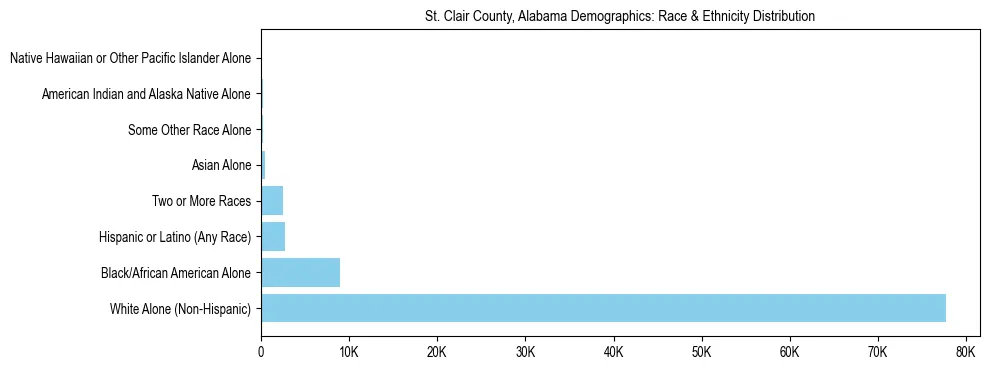
Pie chart showing the racial and ethnic composition of St. Clair County, Alabama based on 2023 ACS data.
Figure 1: Racial and ethnic breakdown of St. Clair County, Alabama. Source: U.S. Census Bureau, 2023 ACS Estimates.

Diversity & Cultural Composition of St. Clair County, Alabama

The racial makeup and ethnic composition of St. Clair County, Alabama are detailed below, drawing from the U.S. Census Bureau's 2023 ACS Estimates.

Diversity Index Score
28.99
Diversity Tier
low
Definition
The probability that two individuals chosen at random from St. Clair County, Alabama will be from different racial or ethnic groups.

St. Clair County, Alabama Population by Race/Ethnicity

Table 1: Population Percentage by Racial and Ethnic Group in St. Clair County, Alabama, 2023
Racial/Ethnic GroupPercentage
White Alone (Non-Hispanic)83.62%
Black/African American Alone9.63%
Hispanic or Latino (Any Race)2.87%
Two or More Races2.74%
Asian Alone0.47%
Some Other Race Alone0.28%
American Indian and Alaska Native Alone0.27%
Native Hawaiian or Other Pacific Islander Alone0.13%

St. Clair County, Alabama Economic Demographics: Household Income Statistics (2023)
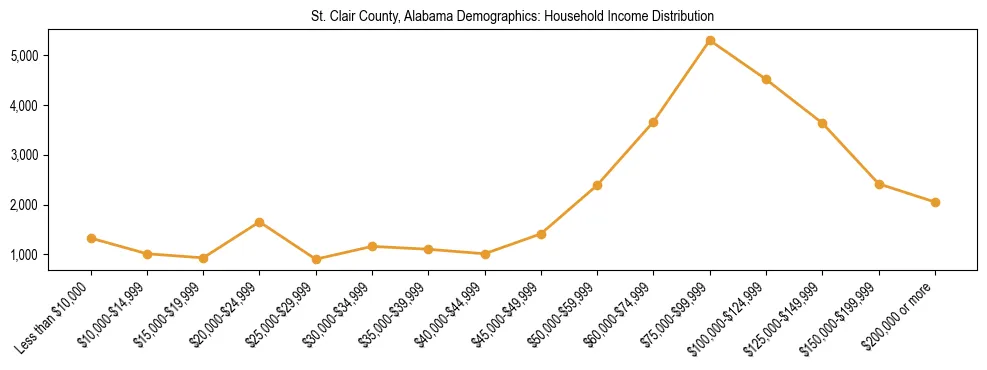
Bar chart showing household income distribution brackets for St. Clair County, Alabama based on 2023 ACS data.
Figure 1: Household income distribution in St. Clair County, Alabama. Source: U.S. Census Bureau, 2023 ACS Estimates.

Economic Snapshot for St. Clair County, Alabama

The following data illustrates the financial landscape of St. Clair County, Alabama, based on the latest U.S. Census Bureau 2023 ACS Estimates.

Median Household Income
$78,993 (Adjusted for inflation)
Total Households Analyzed
34,477

St. Clair County, Alabama Household Income Distribution by Income Brackets

Table 1: Percentage distribution of household income in St. Clair County, Alabama, 2023
Annual Income RangeShare of Households
Less than $20,0009.47%
$20,000 to $34,99910.76%
$35,000 to $49,99910.21%
$50,000 to $74,99917.56%
$75,000 to $149,99939.03%
$150,000 or more12.96%

St. Clair County, Alabama Real Estate Demographics: Property Values (2023)
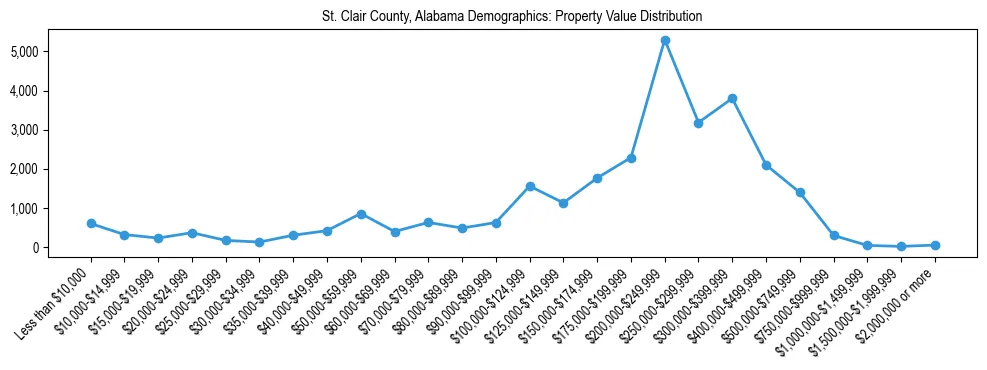
Line chart showing property value distribution for owner-occupied homes in St. Clair County, Alabama based on 2023 ACS data.
Figure 1: Property value distribution in St. Clair County, Alabama. Source: U.S. Census Bureau, 2023 ACS Estimates.

Real Estate Market Snapshot for St. Clair County, Alabama

The following data highlights the distribution of owner-occupied housing values in St. Clair County, Alabama, based on the latest U.S. Census Bureau 2023 ACS Estimates.

Median Property Value
$218,500
Total Properties Analyzed
28,434 (Owner-occupied units)

St. Clair County, Alabama Property Value Brackets

Table 1: Percentage distribution of property values in St. Clair County, Alabama, 2023
Value RangeShare of Properties
Less than $25,0005.32%
$25,000 to $49,9993.57%
$50,000 to $99,99910.51%
$100,000 to $199,99923.70%
$200,000 to $499,99950.59%
$500,000 to $999,9996.08%
$1,000,000 or more0.23%

St. Clair County, Alabama Educational Attainment Statistics (2023)
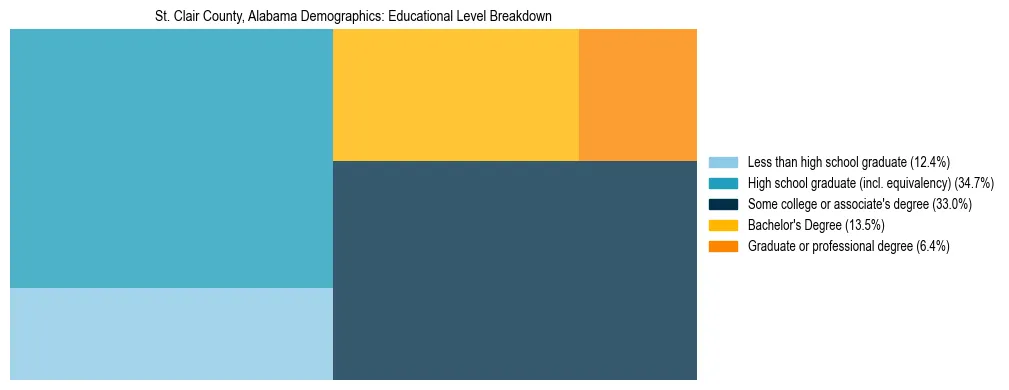
Treemap chart illustrating educational attainment levels for adults 25+ in St. Clair County, Alabama based on 2023 ACS data.
Figure 1: Educational breakdown in St. Clair County, Alabama. Source: U.S. Census Bureau, 2023 ACS Estimates.

Education Snapshot for St. Clair County, Alabama

The following statistics represent the educational background of residents aged 25 and older in St. Clair County, Alabama, based on U.S. Census Bureau 2023 ACS Estimates.

High School Graduate or Higher
87.58%
Bachelor's Degree or Higher
19.94%
Total Population Analyzed (25+)
65,356

St. Clair County, Alabama Education Levels

Table 1: Detailed educational attainment distribution in St. Clair County, Alabama, 2023
Education LevelShare of Population (25+)
Less than high school graduate12.42%
High school graduate (incl. equivalency)34.67%
Some college or associate's degree32.97%
Bachelor's Degree13.50%
Graduate or professional degree6.44%

St. Clair County, Alabama Health Insurance Coverage Statistics (2023)
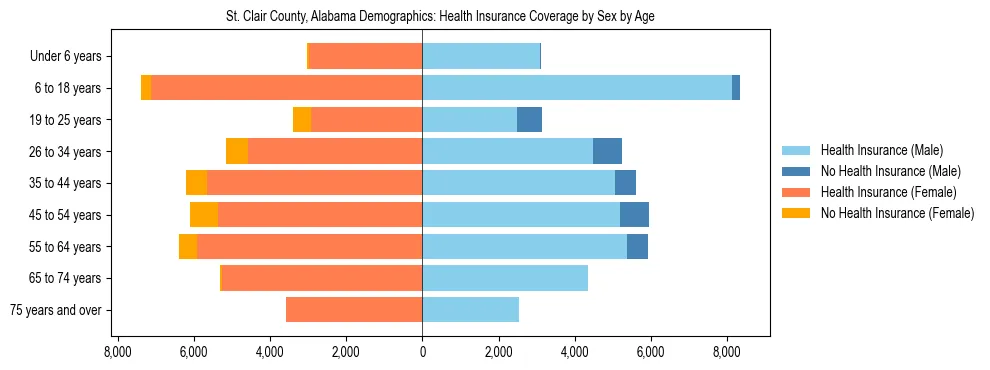
Pyramid chart showing health insurance coverage distribution by age and sex in St. Clair County, Alabama based on 2023 ACS data.
Figure 1: Health insurance coverage gaps in St. Clair County, Alabama. Source: U.S. Census Bureau, 2023 ACS Estimates.

Healthcare Coverage Snapshot for St. Clair County, Alabama

The following data illustrates the health coverage landscape of St. Clair County, Alabama, based on U.S. Census Bureau 2023 ACS Estimates.

Overall Uninsured Rate
7.3%
Total Uninsured Population
6,636
Total Civilian Population
90,751

The uninsured rates vary significantly by demographic group. Children under 18 and seniors aged 65+ generally have higher coverage rates due to public programs like Medicaid/CHIP and Medicare.

St. Clair County, Alabama Uninsured Rates by Demographics

Table 1: Uninsured Rates by Age Group and Sex in St. Clair County, Alabama, 2023
Age GroupMale Uninsured %Female Uninsured %
Under 181.9%3.0%
18-34 years16.7%12.3%
35-64 years10.7%9.4%
65+ years0.0%0.3%

St. Clair County, Alabama Nativity & Citizenship Statistics (2023)
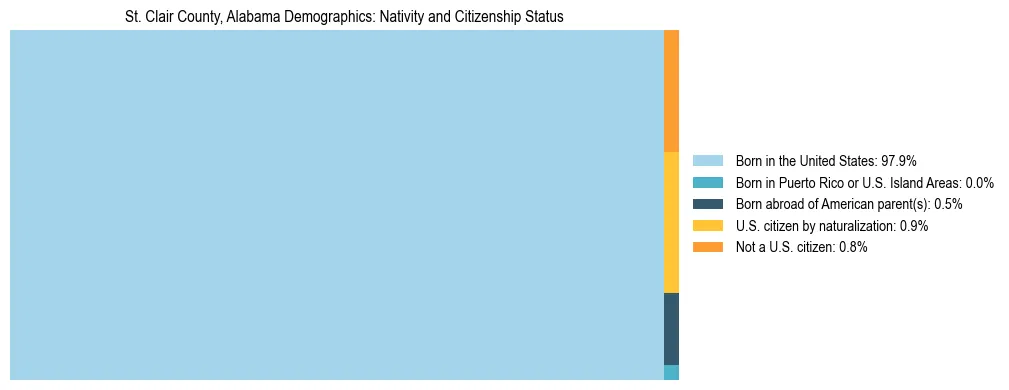
Treemap showing population distribution by nativity and citizenship status in St. Clair County, Alabama based on 2023 ACS data.
Figure 1: Citizenship status breakdown in St. Clair County, Alabama. Source: U.S. Census Bureau, 2023 ACS Estimates.

Citizenship Snapshot for St. Clair County, Alabama

The following data details the citizenship status and nativity of the population in St. Clair County, Alabama, based on U.S. Census Bureau 2023 ACS Estimates.

U.S. Citizenship Rate
99.2% (Native-born + Naturalized)
Naturalized Citizens
829 (Foreign-born individuals who acquired citizenship)
Non-Citizen Residents
716

St. Clair County, Alabama Nativity Breakdown

Table 1: Nativity and Citizenship Distribution in St. Clair County, Alabama, 2023
Nativity/Citizenship StatusPercentage
Born in the United States97.9%
Born in Puerto Rico or U.S. Island Areas0.0%
Born abroad of American parent(s)0.5%
U.S. citizen by naturalization0.9%
Not a U.S. citizen0.8%
Total U.S. Citizens 99.2%

St. Clair County, Alabama Commuting & Transportation Statistics (2023)
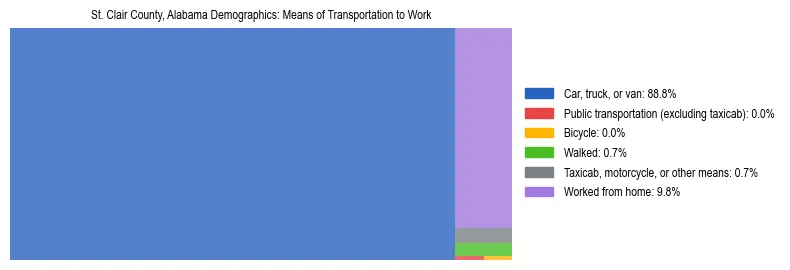
Treemap chart illustrating how workers in St. Clair County, Alabama commute to work based on 2023 ACS data.
Figure 1: Commute mode split in St. Clair County, Alabama. Source: U.S. Census Bureau, 2023 ACS Estimates.

Commuter Snapshot for St. Clair County, Alabama

The following data details the commuting habits of the workforce in St. Clair County, Alabama, based on U.S. Census Bureau 2023 ACS Estimates.

Drove to Work (Car/Truck/Van)
88.8%
Public Transportation Usage
0.0%
Work From Home Rate
9.8%
Total Workers Analyzed
41,794

St. Clair County, Alabama Commute Breakdown

Table 1: Commuting Methods Distribution in St. Clair County, Alabama, 2023
Transportation MethodPercentageNumber of Workers
Car, truck, or van88.8%37,107
Public transportation0.0%0
Bicycle0.0%0
Walked0.7%278
Taxicab, motorcycle, or other means0.7%294
Worked from home9.8%4,115
Total Workers- 41,794

St. Clair County, Alabama Employment by Class of Worker (2023)
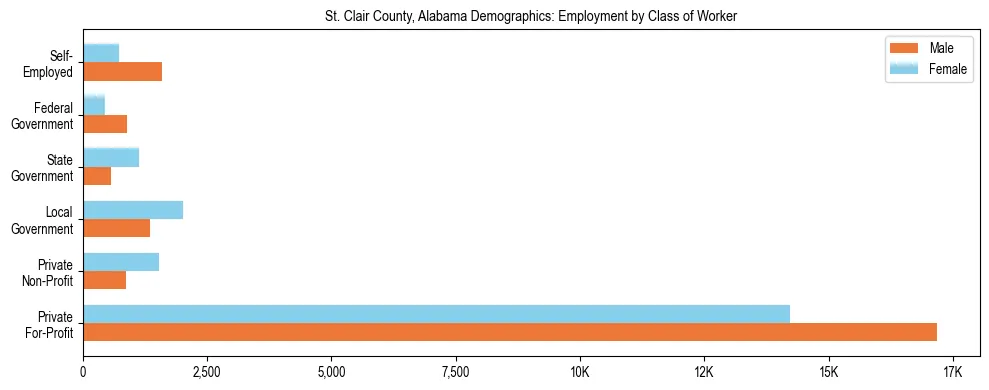
Bar chart showing employment distribution by class of worker (Private, Government, Self-Employed) in St. Clair County, Alabama based on 2023 ACS data.
Figure 1: Workforce composition in St. Clair County, Alabama. Source: U.S. Census Bureau, 2023 ACS Estimates.

Workforce Snapshot for St. Clair County, Alabama

The following statistics categorize the civilian employed population aged 16 and over in St. Clair County, Alabama by their employment sector, based on U.S. Census Bureau 2023 ACS Estimates.

Total Employed Civilian Population
42,532
Private Sector (Profit & Non-Profit)
Includes For-Profit and Non-Profit organizations
Government Workers
Includes Local, State, and Federal employees
Self-Employed Workers
Includes own not incorporated business workers

St. Clair County, Alabama Employment Sector Breakdown

Table 1: Employment Distribution by Class of Worker and Sex in St. Clair County, Alabama, 2023
Employment ClassMale WorkersFemale Workers
Private For-Profit17,187 (40.4%)14,230 (33.5%)
Private Non-Profit870 (2.0%)1,525 (3.6%)
Government (All Levels)2,797 (6.6%)3,579 (8.4%)
• Local Government1,3552,005
• State Government5611,121
• Federal Government881453
Self-Employed1,583 (3.7%)732 (1.7%)

Definitions: "Private sector" includes employees of for-profit and non-profit companies. "Government" includes all local, state, and federal employees. "Self-employed" refers to those operating their own unincorporated businesses.


St. Clair County, Alabama Veteran Population & Service Statistics (2023)
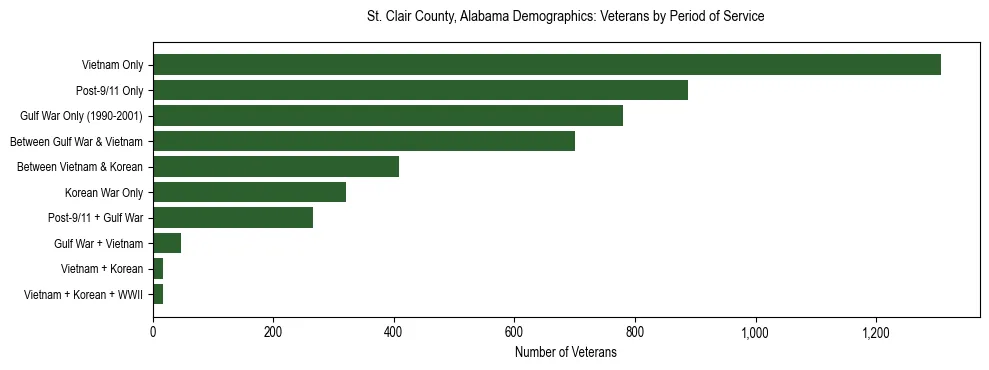
Bar chart showing the distribution of veterans by period of military service in St. Clair County, Alabama based on 2023 ACS data.
Figure 1: Veteran service eras in St. Clair County, Alabama. Source: U.S. Census Bureau, 2023 ACS Estimates.

Veteran Community Snapshot for St. Clair County, Alabama

The following data details the civilian veteran population aged 18 and over in St. Clair County, Alabama, based on U.S. Census Bureau 2023 ACS Estimates.

Total Civilian Veterans
4,770
Primary Service Era
Vietnam Era Only
1,307 veterans (27.4%)

St. Clair County, Alabama Service Period Breakdown

Table 1: Veteran Distribution by Period of Military Service in St. Clair County, Alabama, 2023
Period of ServiceNumber of VeteransPercentage
Vietnam Era Only (August 1964 to April 1975)1,30727.4%
Post-9/11 Only (September 2001 or later)88818.6%
Gulf War Only (August 1990 to August 2001)78116.4%
Between Gulf War and Vietnam Era70014.7%
Between Vietnam Era and Korean War4098.6%
Korean War Only (July 1950 to January 1955)3206.7%
Post-9/11 and Gulf War (August 1990 to August 2001)2665.6%
Gulf War and Vietnam Era471.0%
Vietnam Era and Korean War180.4%
Vietnam Era, Korean War, and World War II170.4%
Post-9/11, Gulf War, and Vietnam Era160.3%
Between Korean War and World War II10.0%
Total Veterans4,770100.0%

Note: Periods of service include World War II (Dec 1941–Dec 1946), Korean War (Jul 1950–Jan 1955), Vietnam Era (Aug 1964–Apr 1975), Gulf War (Aug 1990–Aug 2001), and Post-9/11 (Sept 2001 or later). Veterans may have served in multiple eras.


St. Clair County, Alabama Family Poverty & Income Statistics (2023)
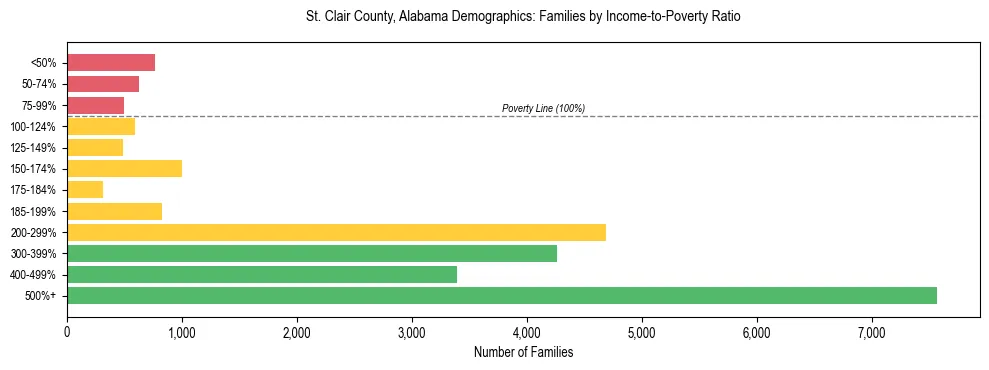
Bar chart showing family distribution by income-to-poverty ratio in St. Clair County, Alabama, based on 2023 ACS data.
Figure 1: Family economic status in St. Clair County, Alabama. Source: U.S. Census Bureau, 2023 ACS Estimates.

Family Economic Security Snapshot for St. Clair County, Alabama

The following data categorizes families in St. Clair County, Alabama by their income relative to the federal poverty threshold, based on U.S. Census Bureau 2023 ACS Estimates.

Families Below Poverty Line (<100%)
7.6% (1,895 families)
Families Near Poverty (100-199%)
31.6% (7,914 families)
Families with Secure Income (200%+)
60.8% (15,220 families)

St. Clair County, Alabama Income-to-Poverty Ratio Breakdown

Table 1: Family Distribution by Income-to-Poverty Ratio in St. Clair County, Alabama, 2023
Income-to-Poverty Ratio CategoryNumber of FamiliesPercentage
Below 50% of Poverty7673.1%
50-74% of Poverty6312.5%
75-99% of Poverty4972.0%
100-124% of Poverty5972.4%
125-149% of Poverty4871.9%
150-174% of Poverty1,0024.0%
175-184% of Poverty3171.3%
185-199% of Poverty8253.3%
200-299% of Poverty4,68618.7%
300-399% of Poverty4,26417.0%
400-499% of Poverty3,39513.6%
500%+ of Poverty7,56130.2%
Total Families25,029100.0%

Definition: The "Income-to-Poverty Ratio" measures a family's income against the federal poverty threshold. A ratio below 1.00 means the family is in poverty. Ratios between 1.00 and 1.99 indicate low income ("near poverty"), while ratios of 2.00 or higher suggest greater economic security.


St. Clair County, Alabama SNAP/Food Stamps Statistics (2023)
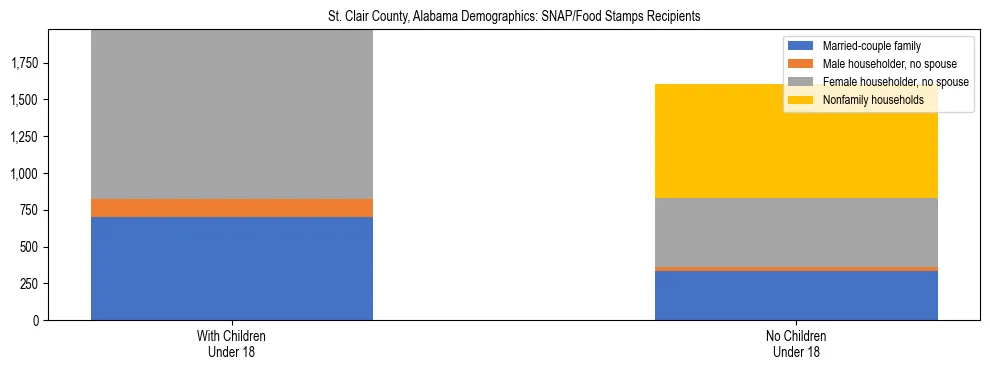
Stacked bar chart showing SNAP recipient household composition by presence of children in St. Clair County, Alabama, based on 2023 ACS data.
Figure 1: SNAP household demographics in St. Clair County, Alabama. Source: U.S. Census Bureau, 2023 ACS Estimates.

SNAP Participation Snapshot for St. Clair County, Alabama

The following data details household participation in the Supplemental Nutrition Assistance Program (SNAP) in St. Clair County, Alabama, based on U.S. Census Bureau 2023 ACS Estimates.

Total Households Receiving SNAP
3,581 (10.39% of all households)
Recipient Households with Children
1,977 (55.21% of recipients)
Total Households Analyzed
34,477

St. Clair County, Alabama SNAP Recipient Demographics

Table 1: SNAP Recipient Household Composition in St. Clair County, Alabama, 2023
Household TypeWith Children Under 18No Children Under 18
Married-Couple Family704 (19.66%)337 (9.41%)
Male Householder, No Spouse117 (3.27%)23 (0.64%)
Female Householder, No Spouse1,156 (32.28%)468 (13.07%)
Nonfamily Households0 (0.00%)776 (21.67%)

About this data: The Supplemental Nutrition Assistance Program (SNAP) provides food assistance to low-income families. Households with children often face higher participation rates due to eligibility guidelines prioritizing child nutrition. "Nonfamily households" typically refer to individuals living alone or with unrelated roommates.


Frequently Asked Questions (FAQs)

The age breakdown for St. Clair County, Alabama is as follows: Under 5: 5.49%, Ages 5–17: 16.92%, Ages 18–24: 7.25%, Ages 25–34: 12.77%, Ages 35–54: 26.51%, Ages 55–64: 13.54%, and 65 or older: 17.53%.

The racial and ethnic composition of St. Clair County, Alabama is dominated by: White Alone (Non-Hispanic): 83.62%, Black/African American Alone: 9.63%, Hispanic or Latino (Any Race): 2.87%. The complete breakdown includes 8 distinct racial and ethnic categories.

The median household income in St. Clair County, Alabama is $78,993. This represents the midpoint of all household incomes in the area, meaning half of households earn more than this amount and half earn less.

The household income distribution in St. Clair County, Alabama is: Very Low Income (under $20,000): 9.47%, Low Income ($20,000-$34,999): 10.76%, Lower Middle Income ($35,000-$49,999): 10.21%, Middle Income ($50,000-$74,999): 17.56%, Upper Middle Income ($75,000-$149,999): 39.03%, High Income ($150,000+): 12.96%.

Approximately 36.61% of households in St. Clair County, Alabama earn over $100,000 annually. This includes households earning between $100,000 and $124,999, $125,000 and $149,999, $150,000 and $199,999, and $200,000 or more.

The median property value for owner-occupied housing units in St. Clair County, Alabama is $218,500. This represents the midpoint of all property values in the area, meaning half of homes are valued above this amount and half are valued below. The median is a better indicator of typical home values than the average because it is not skewed by extremely high or low property values.

The property value distribution for owner-occupied housing units in St. Clair County, Alabama is: Less than $25,000: 5.32%, $25,000-$49,999: 3.57%, $50,000-$99,999: 10.51%, $100,000-$199,999: 23.70%, $200,000-$499,999: 50.59%, $500,000-$999,999: 6.08%, $1,000,000 or more: 0.23%.

There are 28,434 owner-occupied housing units in St. Clair County, Alabama. This represents homes that are owned by the people living in them, as opposed to rental properties or vacant units.

Approximately 6.31% of owner-occupied housing units in St. Clair County, Alabama are valued over $500,000. This includes properties valued between $500,000 and $749,999, $750,000 and $999,999, $1,000,000 and $1,499,999, $1,500,000 and $1,999,999, and $2,000,000 or more.

In St. Clair County, Alabama, 19.94% of the population aged 25 and older holds a bachelor's degree or higher. This includes those with bachelor's degrees as well as those with graduate or professional degrees.

The educational attainment breakdown for St. Clair County, Alabama (population 25+) is: Less than high school graduate: 12.42%, High school graduate (including equivalency): 34.67%, Some college or associate's degree: 32.97%, Bachelor's degree: 13.50%, Graduate or professional degree: 6.44%.

In St. Clair County, Alabama, 87.58% of the population aged 25 and older has completed at least a high school education. This includes high school graduates, those with some college, associate's degrees, bachelor's degrees, and graduate degrees.

In St. Clair County, Alabama, 7.3% of the population lacks health insurance coverage. This represents 6,636 individuals out of a total population of 90,751 people.

The uninsured rates vary by age group in St. Clair County, Alabama. For young adults (18-34 years), 16.7% of males and 12.3% of females lack coverage. In the 35-64 age group, 10.7% of males and 9.4% of females are uninsured. These working-age populations typically face different coverage challenges than children or seniors.

Children under 18 in St. Clair County, Alabama have uninsured rates of 1.9% for males and 3.0% for females. Seniors aged 65 and older, who are typically covered by Medicare, have uninsured rates of 0.0% for males and 0.3% for females. These age groups generally have higher coverage rates due to public programs.

In St. Clair County, Alabama, 99.2% of the population are U.S. citizens. This includes native-born citizens and naturalized citizens. Out of a total population of 92,903 people, 92,187 are U.S. citizens.

St. Clair County, Alabama has 829 naturalized U.S. citizens, representing 0.9% of the total population. These are foreign-born individuals who have gone through the naturalization process to become U.S. citizens.

The nativity and citizenship breakdown for St. Clair County, Alabama is: 97.9% were born in the United States, 0.0% were born in Puerto Rico or U.S. Island Areas, 0.5% were born abroad of American parent(s), 0.9% are foreign-born naturalized U.S. citizens, and 0.8% are foreign-born non-citizens.

In St. Clair County, Alabama, 88.8% of workers commute by car, truck, or van, making it the most common means of transportation to work. Out of 41,794 total workers, 37,107 use personal vehicles for their commute.

0 workers in St. Clair County, Alabama use public transportation (excluding taxicabs) to commute to work, representing 0.0% of all workers. This includes buses, subways, light rail, commuter trains, and ferries.

Alternative commute methods in St. Clair County, Alabama include: 9.8% work from home, 0.7% walk to work, 0.0% bicycle, and 0.7% use other means such as taxicabs or motorcycles. These alternatives to driving alone help reduce traffic congestion and environmental impact.

"Class of worker" refers to the type of employer or work arrangement for employed civilians aged 16 and over in St. Clair County, Alabama. It categorizes workers into private sector (for-profit and non-profit), government (local, state, and federal), self-employed, and unpaid family workers. This classification helps understand the employment structure and economic composition of the workforce.

According to the American Community Survey, St. Clair County, Alabama has 42,532 employed civilians aged 16 and over. The private for-profit sector employs the largest share of workers, with 40.4% of male workers and 33.5% of female workers in this category.

In St. Clair County, Alabama, there are 2,797 male government workers and 3,579 female government workers. Government employment includes local, state, and federal positions. This represents 6.6% of male workers and 8.4% of female workers.

Self-employment in St. Clair County, Alabama includes 1,583 males (3.7%) and 732 females (1.7%). Self-employed workers operate their own businesses that are not legally incorporated.

In St. Clair County, Alabama, 3,581 households (10.39% of all households) received SNAP/Food Stamps benefits in the past 12 months. Out of 34,477 total households, these families rely on this federal nutrition assistance program to help purchase food.

Of the SNAP-receiving households in St. Clair County, Alabama, 1,977 (55.21%) have children under 18 years. These families face additional nutritional needs and food security challenges as they work to provide adequate nutrition for growing children.

SNAP recipients in St. Clair County, Alabama include diverse household types. Among households with children, 1,156 (32.28%) are headed by a female householder with no spouse present, while 704 (19.66%) are married-couple families. The program also serves households without children, including seniors, disabled individuals, and working adults facing economic challenges.

The Supplemental Nutrition Assistance Program (SNAP), formerly known as Food Stamps, is a federal program that provides nutrition assistance to low-income individuals and families. Eligibility is based on household income, resources, and size. In St. Clair County, Alabama, SNAP helps eligible households purchase nutritious food at authorized retailers. The program aims to alleviate hunger and improve nutrition and health outcomes for vulnerable populations.

According to the U.S. Census Bureau's American Community Survey, there are 4,770 civilian veterans aged 18 and over living in St. Clair County, Alabama. These individuals have served on active duty in the U.S. Army, Air Force, Navy, Marine Corps, or Coast Guard. This number does not include those with only National Guard or Reserves training without active duty service.

The most common period of military service for veterans in St. Clair County, Alabama is Vietnam Era Only, with 1,307 veterans (27.4% of all veterans) who served during this period. The second most common period is Post-9/11 Only, with 888 veterans (18.6%).

"Period of service" categorizes veterans based on when they served on active duty in the U.S. Armed Forces. Major periods include World War II (December 1941-December 1946), the Korean War (July 1950-January 1955), the Vietnam Era (August 1964-April 1975), the Gulf War (August 1990-August 2001), and Post-9/11 (September 2001 or later). Veterans may have served during multiple periods. Understanding the distribution of service periods helps communities in St. Clair County, Alabama provide appropriate services and support to their veteran population.

Veterans who served during the Gulf War era (1990-2001) and Post-9/11 era (2001-present) represent approximately 56.6% of all veterans in St. Clair County, Alabama. These more recent-era veterans, totaling around 2,698 individuals, often have different service experiences and support needs compared to veterans of earlier conflicts. They may benefit from targeted programs addressing issues such as transition to civilian life, employment assistance, and access to VA healthcare services.

In St. Clair County, Alabama, 1,895 families (7.6% of all families) live below the federal poverty line. This means their household income is less than 100% of the poverty threshold established by the U.S. Census Bureau, which varies by family size and composition. Out of 25,029 total families, these households face significant economic challenges meeting basic needs.

"Income-to-poverty ratio" measures how a family's income compares to the federal poverty threshold. A ratio of 1.00 (100%) means the family's income equals the poverty line. Below 1.00 indicates poverty, while ratios above 1.00 show income levels relative to poverty. For example, a ratio of 2.00 (200%) means the family earns twice the poverty threshold. In St. Clair County, Alabama, this data helps identify not just families in poverty, but also those who are economically vulnerable despite being above the official poverty line.

Beyond families living in poverty, St. Clair County, Alabama has 7,914 families (31.6%) with incomes between 100% and 199% of the poverty level. These families are often called 'near poverty' or low-income households. Specifically, 2,086 families (8.3%) have incomes between 100% and 149% of poverty. While technically above the poverty line, these families often struggle with housing costs, healthcare, childcare, and other expenses, making them economically vulnerable.

In St. Clair County, Alabama, 767 families (3.1%) live in extreme poverty, with incomes below 50% of the federal poverty threshold. These families face severe economic hardship and often require comprehensive assistance programs. On the other end of the spectrum, 15,220 families (60.8%) have incomes at least 200% above the poverty level, indicating greater financial stability and economic security.