2023 Wilkin County, Minnesota Demographics | Comprehensive Overview
Data and insights for Wilkin County, Minnesota, including population, age & gender distribution, race & ethnicity, median & household income distribution, property value distribution, educational attainment, health insurance coverage, nativity & citizenship, commuting & transportation, employment, veteran service, poverty & income and SNAP/food stamp recipients. Based on 2023 American Community Survey Estimates.
Wilkin County, Minnesota Key Demographic Statistics (2023 Estimates)
Key demographic statistics summarized from the U.S. Census Bureau's 2023 American Community Survey (ACS).
Source: U.S. Census Bureau, 2023 American Community Survey (ACS) Estimates
Wilkin County, Minnesota Demographics: Age & Gender Distribution (2023)
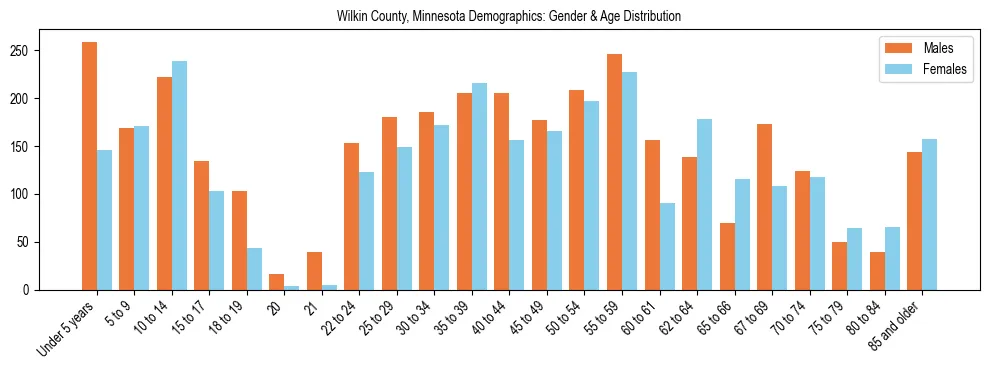
Key Demographic Indicators for Wilkin County, Minnesota
The following statistics highlight Wilkin County, Minnesota population and median age, based on U.S. Census Bureau 2023 ACS Estimates.
- Total Population
- 6,413
- Median Age (Total)
- 42.0 years
- Median Age (Male)
- 41.0 years
- Median Age (Female)
- 44.0 years
Wilkin County, Minnesota Age Distribution Comparison with Minnesota 2023
Compare Wilkin County, Minnesota age demographics with Minnesota to understand regional demographic patterns.
| Metric | Wilkin County, Minnesota | Minnesota | Difference |
|---|---|---|---|
| Median Age | 42.0 yrs | 39.2 yrs | +2.8 yrs |
| Under 5 years | 6.32% | 5.50% | +0.8pp |
| Children (5–17 years) | 16.19% | 16.78% | -0.6pp |
| Young Adults (18–24) | 7.59% | 8.97% | -1.4pp |
| Middle-aged (35–54) | 23.87% | 25.26% | -1.4pp |
| Seniors (65+) | 19.15% | 18.23% | +0.9pp |
| Total Dependency Ratio | 71.38 | 68.11 | +3.3 |
Note: "pp" indicates percentage points. "yrs" indicates years. The dependency ratio measures the burden on working-age population (18-64) to support dependents (under 18 and 65+).
Dependency Ratios Analysis
- Total Dependency Ratio
- 71.38
- Youth Dependency Ratio
- 38.56 Population under 18 relative to working age (18-64).
- Old-Age Dependency Ratio
- 32.82 Population 65+ relative to working age (18-64).
A higher ratio indicates a greater financial and social burden on the working population to support non-working age groups.
Wilkin County, Minnesota Demographics: Racial and Ethnic Composition (2023)
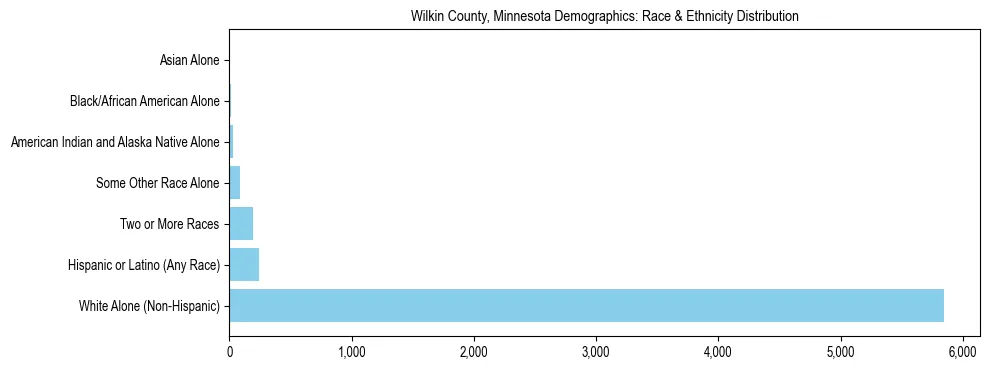
Diversity & Cultural Composition of Wilkin County, Minnesota
The racial makeup and ethnic composition of Wilkin County, Minnesota are detailed below, drawing from the U.S. Census Bureau's 2023 ACS Estimates.
- Diversity Index Score
- 16.57
- Diversity Tier
- very low
- Definition
- The probability that two individuals chosen at random will be from different racial or ethnic groups.
Diversity Comparison with Minnesota
Compare Wilkin County, Minnesota racial and ethnic demographics with Minnesota to understand regional diversity patterns.
Wilkin County, Minnesota Diversity
16.57
very lowMinnesota Diversity
42.65
moderateRacial and Ethnic Composition Comparison
| Racial/Ethnic Group | Wilkin County, Minnesota | Minnesota | Difference |
|---|---|---|---|
| White Alone (Non-Hispanic) | 91.21% | 74.73% | +16.5pp |
| Hispanic or Latino (Any Race) | 3.71% | 6.71% | -3.0pp |
| Two or More Races | 3.04% | 4.67% | -1.6pp |
| Some Other Race Alone | 1.33% | 0.41% | +0.9pp |
| American Indian and Alaska Native Alone | 0.45% | 0.74% | -0.3pp |
| Black/African American Alone | 0.20% | 7.47% | -7.3pp |
| Asian Alone | 0.06% | 5.23% | -5.2pp |
| Native Hawaiian or Other Pacific Islander Alone | 0.00% | 0.05% | -0.1pp |
| Diversity Index Score | 16.57 | 42.65 | -26.08 |
Note: "pp" indicates percentage points. Higher Diversity Index Scores (green) indicate greater racial/ethnic diversity.
Wilkin County, Minnesota Economic Demographics: Household Income Statistics (2023)
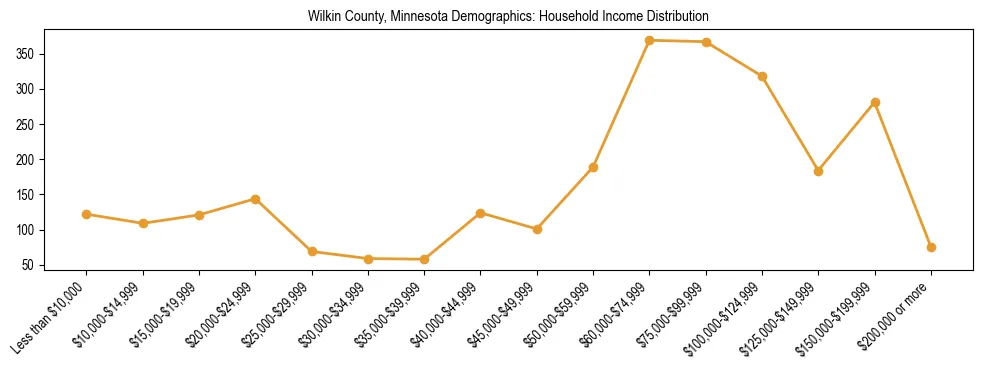
Economic Snapshot for Wilkin County, Minnesota
The following data illustrates the financial landscape of Wilkin County, Minnesota, based on the latest U.S. Census Bureau 2023 ACS Estimates.
- Median Household Income
- $69,635 (Adjusted for inflation)
- Total Households Analyzed
- 2,691
Income Comparison with Minnesota
Compare Wilkin County, Minnesota household income with Minnesota to understand regional economic patterns.
Wilkin County, Minnesota
$69,635
Minnesota
$87,117
Income Distribution Comparison
| Income Bracket | Wilkin County, Minnesota | Minnesota | Difference |
|---|---|---|---|
| Less than $20,000 | 13.08% | 9.38% | +3.7pp |
| $20,000 to $34,999 | 10.11% | 8.17% | +1.9pp |
| $35,000 to $49,999 | 10.52% | 9.14% | +1.4pp |
| $50,000 to $74,999 | 20.74% | 16.16% | +4.6pp |
| $75,000 to $149,999 | 32.29% | 32.69% | -0.4pp |
| $150,000 or more | 13.27% | 24.45% | -11.2pp |
Note: "pp" indicates percentage points. Higher percentages in high-income brackets (green) indicate greater affluence compared to Minnesota.
Wilkin County, Minnesota Real Estate Demographics: Property Values (2023)
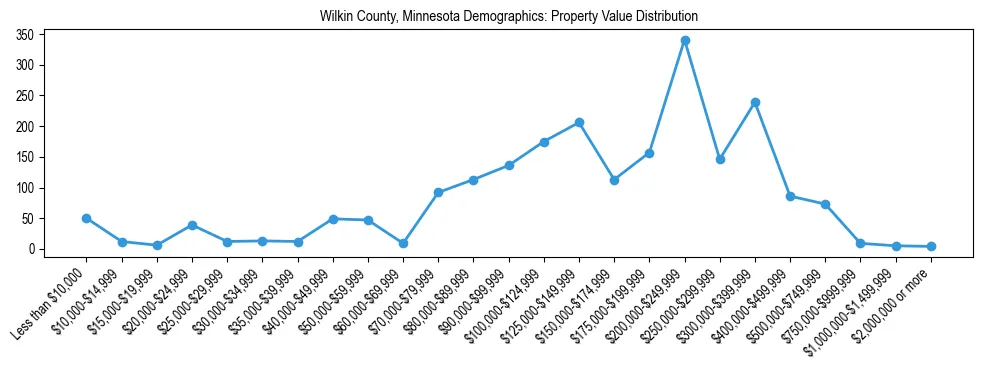
Real Estate Market Snapshot for Wilkin County, Minnesota
The following data highlights the distribution of owner-occupied housing values in Wilkin County, Minnesota, based on the latest U.S. Census Bureau 2023 ACS Estimates.
- Median Property Value
- $172,300
- Total Properties Analyzed
- 2,144 (Owner-occupied units)
Property Value Comparison with Minnesota
Compare Wilkin County, Minnesota property values with Minnesota to understand regional real estate market patterns.
Wilkin County, Minnesota
$172,300
Minnesota
$344,600
Property Value Distribution Comparison
| Value Bracket | Wilkin County, Minnesota | Minnesota | Difference |
|---|---|---|---|
| Less than $25,000 | 4.99% | 2.16% | +2.8pp |
| $25,000 to $49,999 | 4.01% | 1.70% | +2.3pp |
| $50,000 to $99,999 | 18.52% | 3.09% | +15.4pp |
| $100,000 to $199,999 | 30.36% | 11.21% | +19.1pp |
| $200,000 to $499,999 | 37.87% | 59.77% | -21.9pp |
| $500,000 to $999,999 | 4.06% | 20.90% | -16.8pp |
| $1,000,000 or more | 0.19% | 1.17% | -1.0pp |
Note: "pp" indicates percentage points. Higher percentages in high-value brackets (green) indicate more expensive real estate compared to Minnesota.
Wilkin County, Minnesota Educational Attainment Statistics (2023)
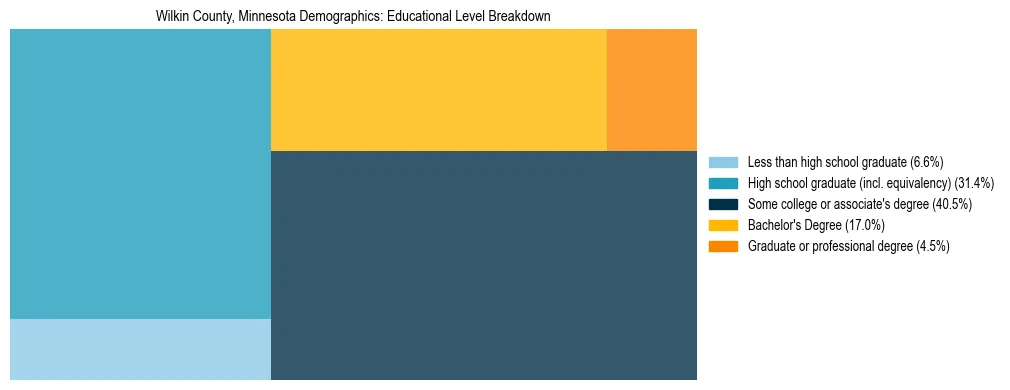
Education Snapshot for Wilkin County, Minnesota
The following statistics represent the educational background of residents aged 25 and older in Wilkin County, Minnesota, based on U.S. Census Bureau 2023 ACS Estimates.
- High School Graduate or Higher
- 93.44%
- Bachelor's Degree or Higher
- 21.53%
- Total Population Analyzed (25+)
- 4,483
Education Level Comparison with Minnesota
Compare Wilkin County, Minnesota educational attainment with Minnesota to understand regional education patterns.
Bachelor's+ in Wilkin County, Minnesota
21.53%
Bachelor's+ in Minnesota
40.03%
Detailed Education Level Comparison
| Education Level | Wilkin County, Minnesota | Minnesota | Difference |
|---|---|---|---|
| Less than HS | 6.56% | 5.80% | +0.8pp |
| HS Graduate | 31.39% | 22.98% | +8.4pp |
| Some College/Associate's | 40.53% | 31.19% | +9.3pp |
| Bachelor's Degree | 17.00% | 26.04% | -9.0pp |
| Graduate/Professional | 4.53% | 13.99% | -9.5pp |
| HS Graduate or Higher | 93.44% | 94.20% | -0.8pp |
Note: "pp" indicates percentage points. Higher percentages in advanced education levels (green badges) indicate higher educational attainment compared to Minnesota.
Wilkin County, Minnesota Health Insurance Coverage Statistics (2023)
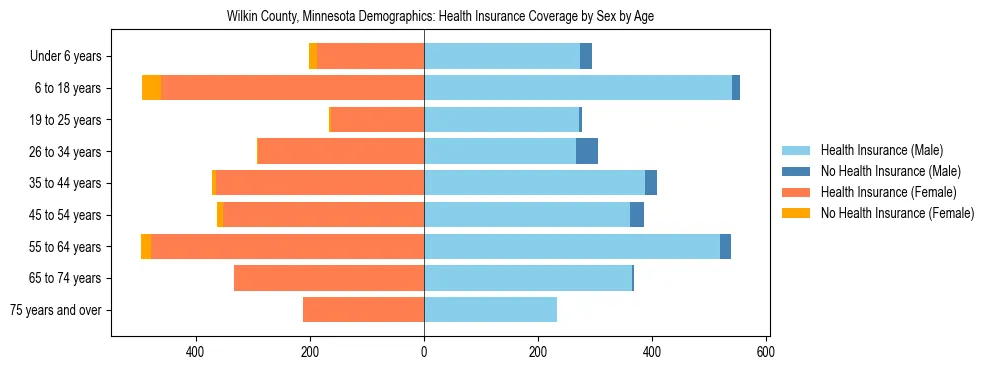
Healthcare Coverage Snapshot for Wilkin County, Minnesota
The following data illustrates the health coverage landscape of Wilkin County, Minnesota, based on U.S. Census Bureau 2023 ACS Estimates.
- Overall Uninsured Rate
- 3.7%
- Total Uninsured Population
- 233
- Total Civilian Population
- 6,295
The uninsured rates vary significantly by demographic group. Children under 18 and seniors aged 65+ generally have higher coverage rates due to public programs like Medicaid/CHIP and Medicare.
Health Insurance Coverage Comparison with Minnesota
Compare Wilkin County, Minnesota health insurance coverage with Minnesota to understand regional healthcare access patterns.
Uninsured in Wilkin County, Minnesota
3.7%
Uninsured in Minnesota
5.1%
Uninsured Rates by Age and Sex
| Age Group | Wilkin County, Minnesota | Minnesota | ||
|---|---|---|---|---|
| Male | Female | Male | Female | |
| Under 18 | 4.1% | 6.8% | 3.8% | 3.6% |
| 18-34 years | 7.6% | 0.9% | 10.7% | 8.0% |
| 35-64 years | 4.9% | 2.8% | 6.7% | 4.9% |
| 65+ years | 0.5% | 0.0% | 0.5% | 0.4% |
Note: Lower uninsured rates indicate better health insurance coverage. The 18-34 age group typically has the highest uninsured rates, while seniors 65+ have near-universal coverage through Medicare.
Wilkin County, Minnesota Nativity & Citizenship Statistics (2023)
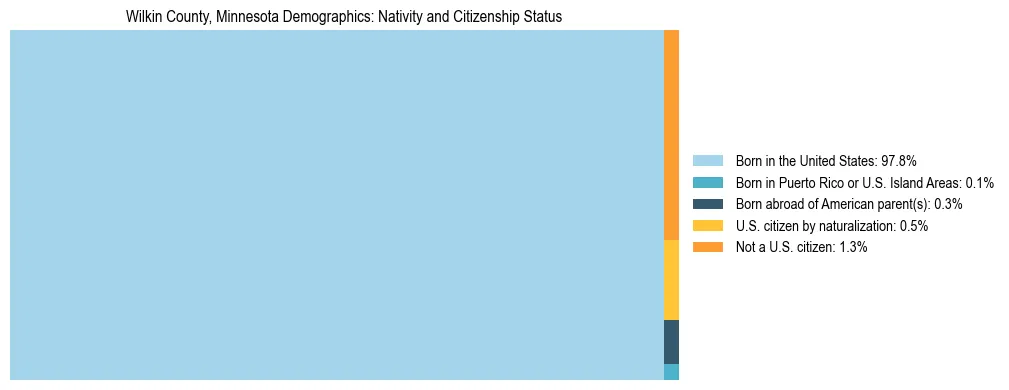
Citizenship Snapshot for Wilkin County, Minnesota
The following data details the citizenship status and nativity of the population in Wilkin County, Minnesota, based on U.S. Census Bureau 2023 ACS Estimates.
- U.S. Citizenship Rate
- 98.7% (Native-born + Naturalized)
- Naturalized Citizens
- 32 (Foreign-born individuals who acquired citizenship)
- Non-Citizen Residents
- 84
Citizenship Comparison with Minnesota
Compare Wilkin County, Minnesota citizenship and nativity with Minnesota to understand regional immigration and naturalization patterns.
Citizenship in Wilkin County, Minnesota
98.7%
Citizenship in Minnesota
96.2%
Nativity and Citizenship Comparison
| Nativity/Citizenship Status | Wilkin County, Minnesota | Minnesota | Difference |
|---|---|---|---|
| Born in the United States | 97.8% | 89.9% | +7.9pp |
| Born in PR or U.S. Territories | 0.1% | 0.2% | -0.1pp |
| Born abroad of American parent(s) | 0.3% | 0.8% | -0.5pp |
| U.S. citizen by naturalization | 0.5% | 5.3% | -4.8pp |
| Not a U.S. citizen | 1.3% | 3.8% | -2.5pp |
| Total U.S. Citizens | 98.7% | 96.2% | +2.5pp |
Note: "pp" indicates percentage points. Higher naturalization rates (green) indicate greater immigrant integration compared to Minnesota.
Wilkin County, Minnesota Commuting & Transportation Statistics (2023)
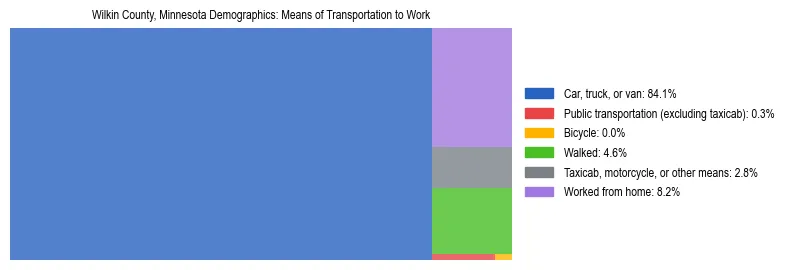
Commuter Snapshot for Wilkin County, Minnesota
The following data details the commuting habits of the workforce in Wilkin County, Minnesota, based on U.S. Census Bureau 2023 ACS Estimates.
- Drove to Work (Car/Truck/Van)
- 84.1%
- Public Transportation Usage
- 0.3%
- Work From Home Rate
- 8.2%
- Total Workers Analyzed
- 3,043
Transportation Comparison with Minnesota
Compare Wilkin County, Minnesota commuting patterns with Minnesota to understand regional transportation preferences.
Drove in Wilkin County, Minnesota
84.1%
Drove in Minnesota
78.9%
Commute Mode Comparison
| Transportation Method | Wilkin County, Minnesota | Minnesota | Difference |
|---|---|---|---|
| Car, truck, or van | 84.1% | 78.9% | +5.2pp |
| Public transportation | 0.3% | 1.8% | -1.5pp |
| Bicycle | 0.0% | 0.6% | -0.6pp |
| Walked | 4.6% | 2.6% | +2.0pp |
| Taxicab, motorcycle, or other | 2.8% | 1.5% | +1.3pp |
| Worked from home | 8.2% | 14.7% | -6.5pp |
Note: "pp" indicates percentage points. Higher public transit or work-from-home rates (green) indicate more diverse commuting options compared to Minnesota.
Wilkin County, Minnesota Employment by Class of Worker (2023)
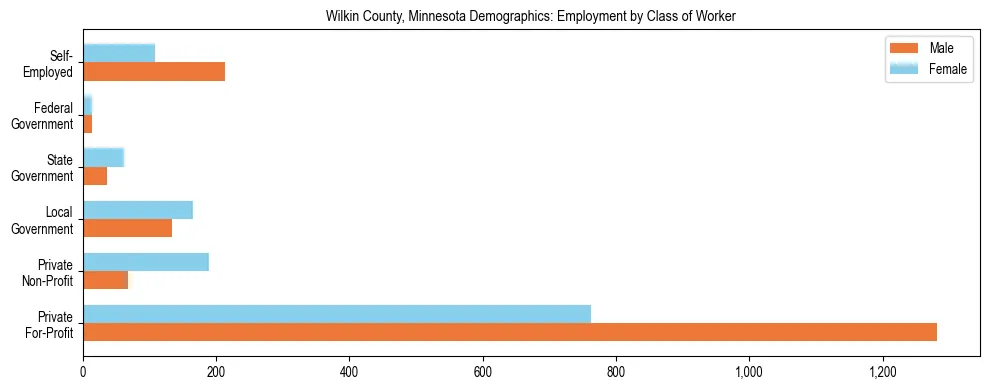
Workforce Snapshot for Wilkin County, Minnesota
The following statistics categorize the civilian employed population aged 16 and over in Wilkin County, Minnesota by their employment sector, based on U.S. Census Bureau 2023 ACS Estimates.
- Total Employed Civilian Population
- 3,073
- Private Sector (Profit & Non-Profit)
- Includes For-Profit and Non-Profit organizations
- Government Workers
- Includes Local, State, and Federal employees
- Self-Employed Workers
- Includes own not incorporated business workers
Employment Sector Comparison with Minnesota
Compare Wilkin County, Minnesota employment patterns with Minnesota to understand regional workforce composition differences.
Government Employment in Wilkin County, Minnesota
6.0% (M) / 7.8% (F)
Government Employment in Minnesota
5.2% (M) / 7.6% (F)
Employment Sector Comparison
| Employment Sector | Wilkin County, Minnesota | Minnesota | Difference |
|---|---|---|---|
| Private For-Profit (Combined) | M: 41.7% F: 24.8% | M: 39.2% F: 30.1% | M: +2.5pp F: -5.3pp |
| Private Non-Profit | M: 2.2% F: 6.2% | M: 4.2% F: 8.5% | M: -2.0pp F: -2.3pp |
| Government (All Levels) | M: 6.0% F: 7.8% | M: 5.2% F: 7.6% | M: +0.8pp F: +0.2pp |
| Self-Employed | M: 6.9% F: 3.5% | M: 3.2% F: 2.0% | M: +3.7pp F: +1.5pp |
Note: "pp" indicates percentage points. M = Male, F = Female. Green badges indicate higher government employment compared to Minnesota.
Definitions: "Private sector" includes employees of for-profit and non-profit companies. "Government" includes all local, state, and federal employees. "Self-employed" refers to those operating their own unincorporated businesses.
Wilkin County, Minnesota Veteran Population & Service Statistics (2023)
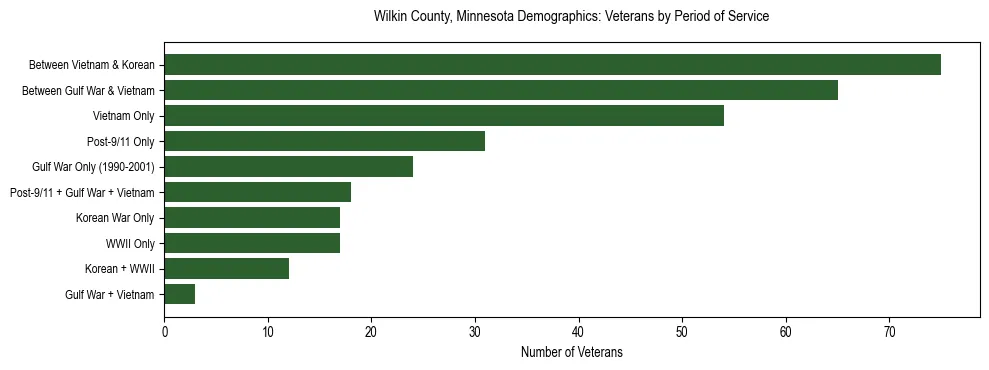
Veteran Community Snapshot for Wilkin County, Minnesota
The following data details the civilian veteran population aged 18 and over in Wilkin County, Minnesota, based on U.S. Census Bureau 2023 ACS Estimates.
- Total Civilian Veterans
- 317
- Primary Service Era
- Between Vietnam & Korean
75 veterans (23.7%)
Veteran Population Comparison with Minnesota
Compare Wilkin County, Minnesota veteran demographics with Minnesota to understand regional veteran service patterns.
Total Veterans in Wilkin County, Minnesota
317
Total Veterans in Minnesota
267,133
- Wilkin County, Minnesota: Between Vietnam & Korean (23.7%)
- Minnesota: Vietnam Era Only (36.7%)
Service Period Distribution Comparison
| Service Period | Wilkin County, Minnesota | Minnesota | Difference |
|---|---|---|---|
| Between Vietnam & Korean | 23.7% (75) | 8.7% (23,167) | +15.0pp |
| Between Gulf War & Vietnam | 20.5% (65) | 14.8% (39,640) | +5.7pp |
| Vietnam Era Only | 17.0% (54) | 36.7% (98,125) | -19.7pp |
| Post-9/11 Only | 9.8% (31) | 14.2% (37,895) | -4.4pp |
| Gulf War Only | 7.6% (24) | 10.9% (29,241) | -3.3pp |
| Post-9/11 + Gulf War + Vietnam | 5.7% (18) | 0.2% (628) | +5.5pp |
| Korean War Only | 5.4% (17) | 6.5% (17,452) | -1.1pp |
| WWII Only | 5.4% (17) | 1.6% (4,370) | +3.8pp |
| Korean + WWII | 3.8% (12) | 0.1% (342) | +3.7pp |
| Gulf War + Vietnam | 0.9% (3) | 0.9% (2,303) | 0.0pp |
| Post-9/11 + Gulf War | 0.3% (1) | 4.7% (12,667) | -4.4pp |
Note: "pp" indicates percentage points. Comparisons show relative proportions of veteran populations by service era.
Note: Periods of service include World War II (Dec 1941–Dec 1946), Korean War (Jul 1950–Jan 1955), Vietnam Era (Aug 1964–Apr 1975), Gulf War (Aug 1990–Aug 2001), and Post-9/11 (Sept 2001 or later). Veterans may have served in multiple eras.
Wilkin County, Minnesota Family Poverty & Income Statistics (2023)
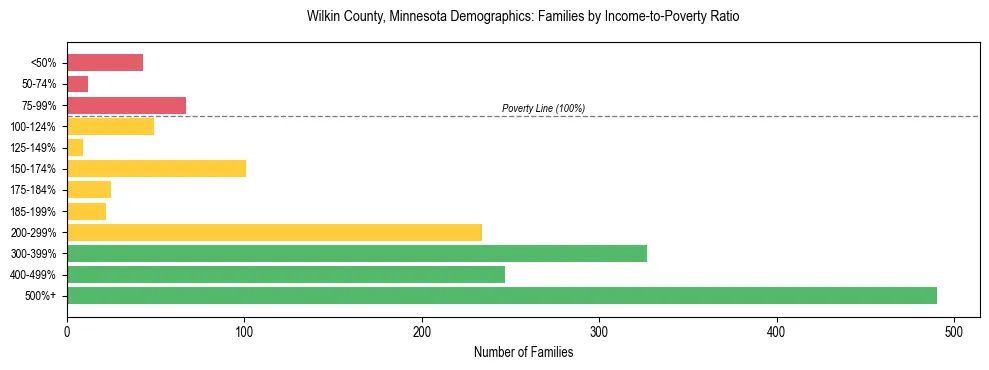
Family Economic Security Snapshot for Wilkin County, Minnesota
The following data categorizes families in Wilkin County, Minnesota by their income relative to the federal poverty threshold, based on U.S. Census Bureau 2023 ACS Estimates.
- Families Below Poverty Line (<100%)
- 7.5% (122 families)
- Families Near Poverty (100-199%)
- 27.1% (440 families)
- Families with Secure Income (200%+)
- 65.4% (1,064 families)
Poverty Rate Comparison with Minnesota
Compare Wilkin County, Minnesota poverty levels with Minnesota to understand regional economic disparities.
Poverty Rate in Wilkin County, Minnesota
7.5%
Below poverty linePoverty Rate in Minnesota
5.7%
Below poverty lineIncome-to-Poverty Ratio Distribution Comparison
| Income Category | Wilkin County, Minnesota | Minnesota | Difference |
|---|---|---|---|
| Below Poverty (<100%) | 7.5% (122) | 5.7% (83,579) | +1.8pp |
| Near Poverty (100-199%) | 27.1% (440) | 22.8% (331,462) | +4.3pp |
| Economic Security (200%+) | 65.4% (1,064) | 71.5% (1,038,899) | -6.1pp |
| Detailed Breakdown | |||
| Below 50% of Poverty | 2.6% | 2.7% | -0.1pp |
| 50-74% of Poverty | 0.7% | 1.5% | -0.8pp |
| 75-99% of Poverty | 4.1% | 1.6% | +2.5pp |
| 100-124% of Poverty | 3.0% | 2.1% | +0.9pp |
| 125-149% of Poverty | 0.6% | 2.4% | -1.8pp |
| 150-174% of Poverty | 6.2% | 2.6% | +3.6pp |
Note: "pp" indicates percentage points. Red badges indicate higher poverty; green badges indicate lower poverty compared to Minnesota.
Definition: The "Income-to-Poverty Ratio" measures a family's income against the federal poverty threshold. A ratio below 1.00 means the family is in poverty. Ratios between 1.00 and 1.99 indicate low income ("near poverty"), while ratios of 2.00 or higher suggest greater economic security.
Wilkin County, Minnesota SNAP/Food Stamps Statistics (2023)
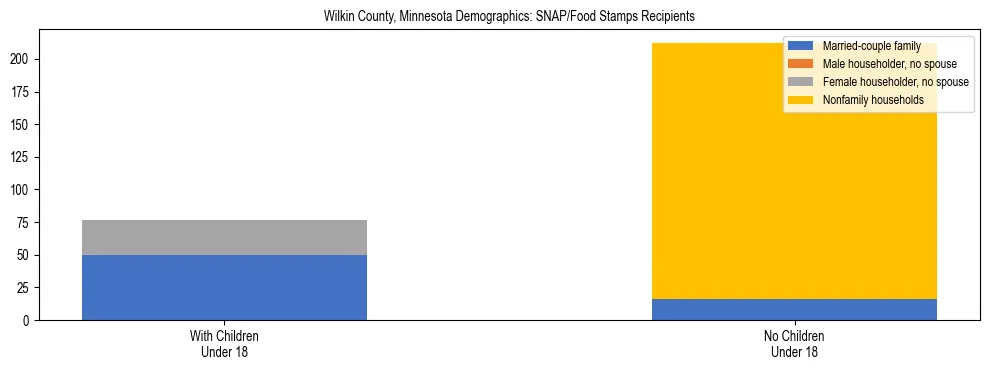
SNAP Participation Snapshot for Wilkin County, Minnesota
The following data details household participation in the Supplemental Nutrition Assistance Program (SNAP) in Wilkin County, Minnesota, based on U.S. Census Bureau 2023 ACS Estimates.
- Total Households Receiving SNAP
- 289 (10.74% of all households)
- Recipient Households with Children
- 77 (26.64% of recipients)
- Total Households Analyzed
- 2,691
SNAP Participation Comparison with Minnesota
Compare Wilkin County, Minnesota SNAP participation with Minnesota to understand regional food assistance needs.
SNAP Participation in Wilkin County, Minnesota
10.74%
289 householdsSNAP Participation in Minnesota
8.34%
197,010 householdsSNAP Household Composition Comparison
| Household Type | Wilkin County, Minnesota | Minnesota | ||
|---|---|---|---|---|
| With Children | No Children | With Children | No Children | |
| Married-Couple Family | 17.30% (50) | 5.54% (16) | 14.60% (28,762) | 5.63% (11,094) |
| Male Householder, No Spouse | 0.00% (0) | 0.00% (0) | 4.51% (8,880) | 2.70% (5,328) |
| Female Householder, No Spouse | 9.34% (27) | 0.00% (0) | 20.70% (40,785) | 8.35% (16,444) |
| Nonfamily Households | 0.00% (0) | 67.82% (196) | 0.76% (1,491) | 42.75% (84,226) |
| Total SNAP Recipients | 289 (10.74% of households) | 197,010 (8.34% of households) | ||
Note: Percentages represent the share of SNAP-receiving households in each category. Higher percentages in households with children often indicate targeting of families with greater nutritional needs.
About this data: The Supplemental Nutrition Assistance Program (SNAP) provides food assistance to low-income families. Households with children often face higher participation rates due to eligibility guidelines prioritizing child nutrition. "Nonfamily households" typically refer to individuals living alone or with unrelated roommates.